Proactive Security by Design
An independent review of your application and system design; including data flows, integrations, and third-party services, is the most efficient way to mitigate security risks.
Codific provides specialized threat modeling services that pinpoint high-risk architectural vulnerabilities early, delivering concrete, practical guidance to address them before they reach production.
Why invest in Application Threat Modeling?
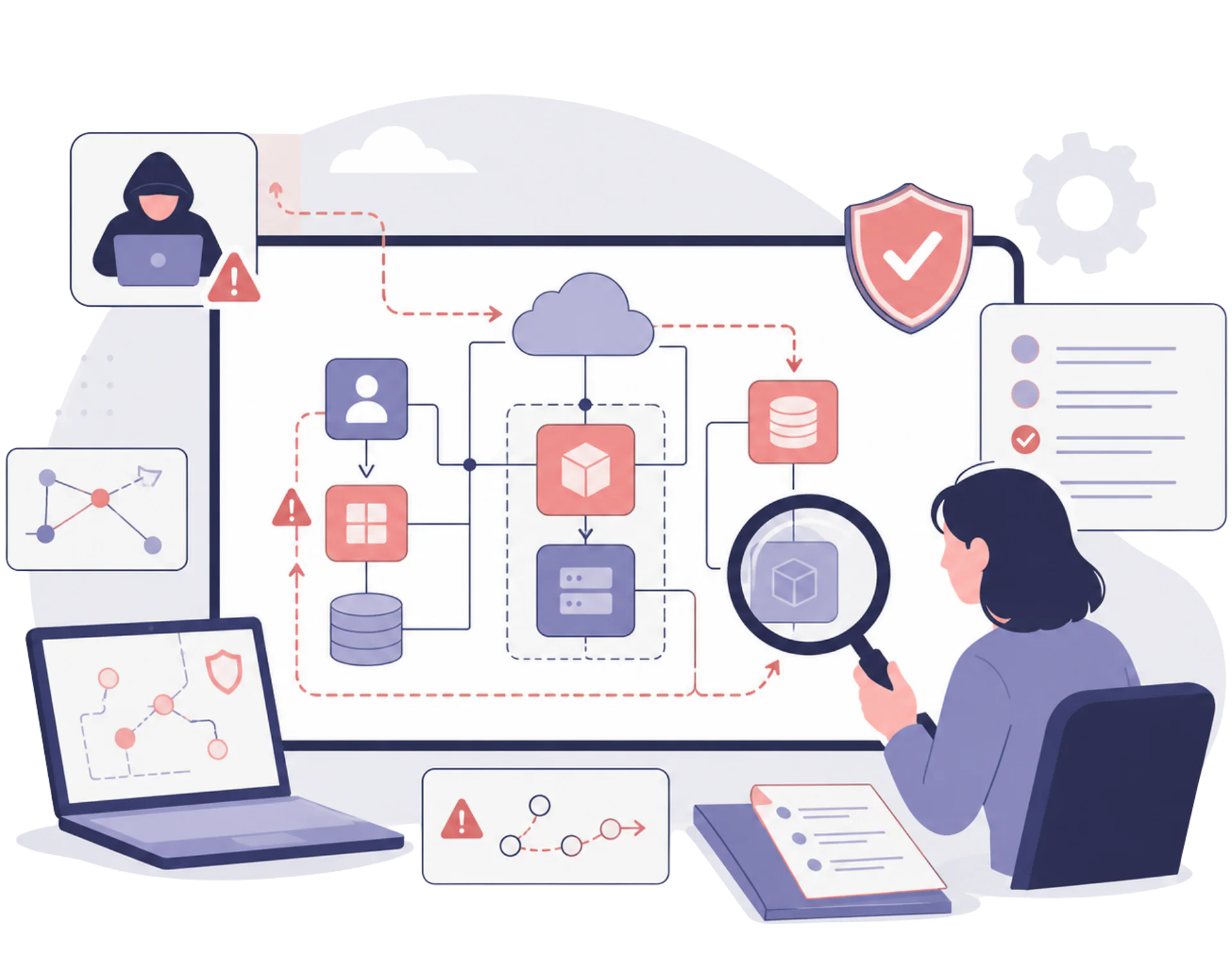
Penetration testing and automated scanning catch bugs in existing code, but systemic architectural flaws require a structural approach. Threat modeling evaluates how your software components, APIs, cloud infrastructure, and third-party integrations interact.
By mapping trust boundaries early in the Software Development Life Cycle (SDLC), you embed security directly into your product design while significantly reducing long-term remediation costs.
Our approach
We integrate with your engineering team to deliver actionable security insights without slowing down development velocity:

- Collaborative Design Sessions
We work alongside your architects and developers to map system components, data flows, trust boundaries, and existing security controls.
- Attack-Path Analysis
Using established threat frameworks, we analyze realistic attack vectors, evaluate risk severity, and present actionable findings in a clear, prioritized report.
- Flexible Delivery Models
Delivered as a one-time deep-dive audit for critical releases or as a scalable, repeatable threat modeling process your internal engineering team can own.
Key Outcomes
Early Risk Identification
Catch high-risk architectural threats early in the design phase, when they are least costly and easiest to fix.
Shared Architectural Understanding
Establish a documented, transparent view of your application architecture, data paths, and security posture across engineering and executive stakeholders.
Sustainable Internal Capability
Build internal expertise and empower your team to run threat modeling autonomously as systems and features evolve.
Secure your architecture with Codific
Ready to build security into the foundation of your software? Contact Codific today to schedule a Secure Architecture Review or discuss a tailored threat modeling program for your organization.
Our own threat modeling tool
SAMMY is Codific’s engineering-led Product Risk and Compliance (PRC) platform designed to shift organizations away from legacy GRC spreadsheets and integrate security seamlessly into technical workflows. It bridges software architecture models with regulatory compliance, transforming technical design reviews into audit-ready documentation.
Key Capabilities
Centralized Product Risk Registry:
Scope digital assets, categorize products by business units, set criticality tiers, and define baseline security using the CIA triad (Confidentiality, Integrity, Availability).
System Context Definition:
Document early architectural assumptions and technical constraints to anchor threat assessments and provide clarity on core boundaries.
Structured Risk Scenarios:
Contextualize design risks using standard frameworks like STRIDE (Spoofing, Tampering, Info Disclosure, Repudiation, Denial of Service, Elevation of Privilege) to generate highly specific threat scenarios with granular impact assessments.
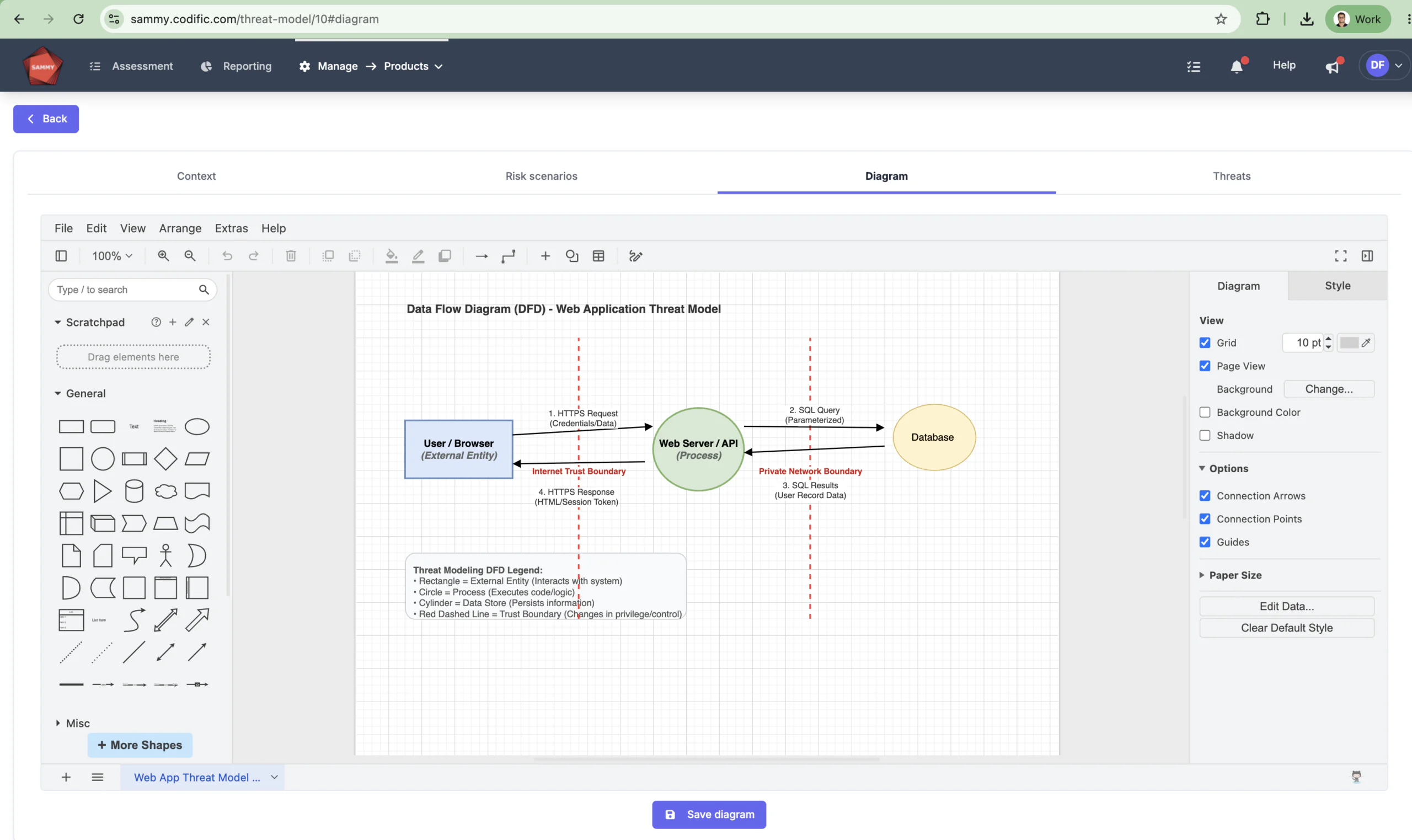
Interactive Data Flow Diagrams (DFDs):
Visually map information flows, process components, and trust boundaries on a native diagramming canvas to pinpoint and visualize your attack surface.
Definitive Threat Management:
Maintain a living ledger of software security risks that tracks technical mitigations, ownership, impact, and likelihood to prove active risk ownership.
Guidance from recognised leaders in
application security
You will be led directly by two of the most experienced practitioners in the
field; both active contributors to the OWASP frameworks the industry is built on.

Aram Hovsepyan
Founder & CEO, Codific · PhD, Application Security
Aram has spent over 15 years working in application security as a researcher, industry expert, and core contributor to the OWASP SAMM project, and is a founding board member of OWASP EU. He holds a PhD in application security from DistriNet KU Leuven, and his work on refining the LINDDUN privacy engineering methodology has been incorporated into both ISO and NIST standards.
Aram is also the founder and CEO of Codific, a cybersecurity company focused on application security and secure software development.

Brian Glas
Application Security Leader · VP of Consulting Services
Brian Glas has spent over 20 years working in information and application security as an engineer, program leader, and consultant, and is a long-standing contributor to the OWASP community. He is a project lead on the OWASP SAMM project and the SAMM Benchmark, and a core contributor to the OWASP Top 10 (2017, 2021, and 2025).
He has previously served on Microsoft’s Trustworthy Computing team and as Chair and Assistant Professor of Computer Science, teaching computer science and cybersecurity.
Verify Once, Comply Many
By adhering to the “Verify Once, Comply Many” philosophy, SAMMY bridges technical architecture directly with regulatory standards. A single architectural review automatically generates the necessary documentation to satisfy requirements for the EU Cyber Resilience Act (CRA), NIST SSDF, and ISO 21434 simultaneously.
Our own threat modeling methodology
The Codific team has also developed our own threat modeling methodology, we will soon publish this methodology for the community to use. Stay tuned.