8 June, 2026
While the European Union accelerates toward a more regulated digital landscape with the Cyber Resilience Act and NIS2, the backbone of its economics SMEs remains perilously exposed. A comprehensive application security maturity assessment by PXL University of Applied Sciences and Arts gives us some insights. Utilizing the OWASP SAMM framework and the relevant industry benchmarks and target postures, reveals a critical structural imbalance in software development. The research finds that while Belgian SMEs excel at reactive operational management, they are almost entirely neglecting proactive security measures like threat modeling and developer education. This article explores the findings, the economic “security debt” being accrued, and the urgent necessity of a “shift-left” strategy for cyber-resilience.
Introduction: The backbone of the digital economy
Located at the “heart of Europe,” approximately 50 kilometers from Brussels, the Belgian region of Flanders serves as a critical hub for software innovation. In this landscape, small-to-medium enterprises (SMEs) are not merely participants; they are the industry’s engine, representing approximately 99% of the industrial landscape. These companies hold a software market share of between 50% and 60%, meaning the products they develop end up in the hands of millions of daily users and large-scale corporate infrastructures.
Despite their significance, the cybersecurity maturity of these organizations has remained a “blind spot” in both scientific literature and practical application. A research team from PXL University of Applied Sciences and Arts, led by Cyber Security Research Coordinator Dr. Koen Gilissen and researcher Savannah Eggers, recently set out to map this maturity using a rigorous, internationally recognized framework.
Their findings suggest that the digital foundation of Europe is built on a “reactive” rather than “proactive” culture, a trend that poses significant risks as global cyber threats continue to increase exponentially.
How to do an application security maturity assessment
To measure the security posture of these SMEs, the PXL team utilized the OWASP Software Assurance Maturity Model (SAMM). OWASP (the Open Worldwide Application Security Project) is a non-profit foundation providing community-driven resources that act as the “gold standard” for application security.
SAMM assesses an organization across five functional pillars, each essential to a secure Software Development Life Cycle (SDLC):
- Governance: Strategy, metrics, policy, compliance, and education.
- Design: Threat assessment, security requirements, and secure architecture.
- Implementation: Secure build, secure deployment, and defect management.
- Verification: Architecture assessment, requirements-driven testing, and security testing.
- Operations: Incident, environment, and operational management.
The assessment was facilitated by the SAMMY tool, the globally recognised OWASP SAMM tool created by Codific in Leuven, Belgium. SAMMY allows researchers to visualize gaps, map results to compliance frameworks like ISO 27001, and provide a clear roadmap for improvement.
The research findings: a “critical structural imbalance”
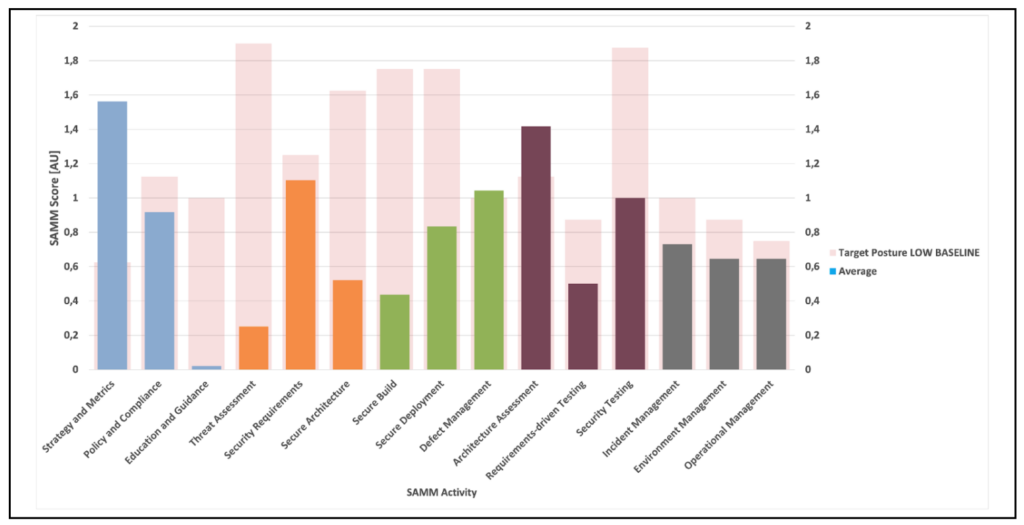
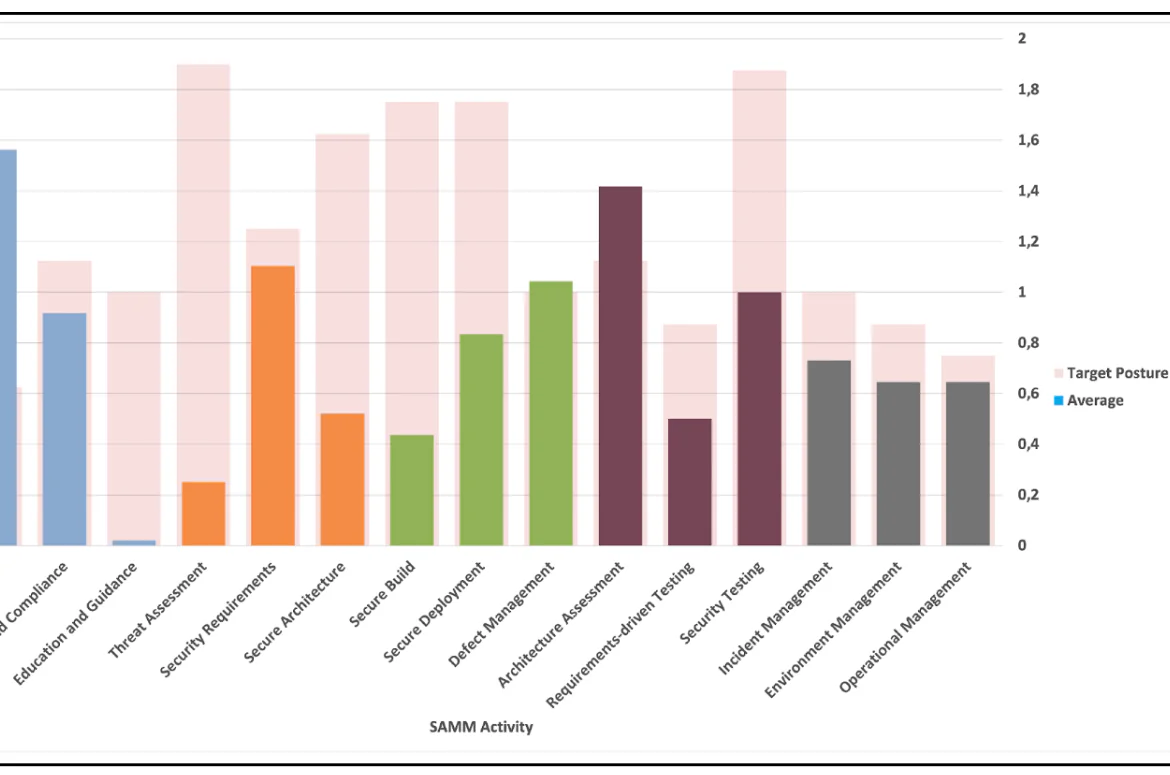
Application Security Maturity Assessment of SMEs vs SAMM low baseline
The analysis of Flemish software SMEs exposed a stark reality: security is often treated as a “thin sauce” poured over the end product rather than being embedded within the software itself.
The “Operations” illusion
The PXL study found that SMEs score relatively high in the Operations pillar. In fact, scores for Environment Management and Operational Management actually exceeded the “Target Posture LOW BASELINE” – the minimum requirement to avoid being considered an “easy target”. This indicates that Belgian SMEs are competent at managing systems that are already “live”.
The proactive gap
However, the “proactive” phases of the SDLC, specifically Governance and Design, showed alarming deficiencies. The most pressing observations involved two critical activities:
- Education and Guidance: Measured at a staggering 0.02 average, compared to a target baseline of 1.0.
- Threat Assessment: Measured at 0.25 average, against a target of 1.9.
Dr. Gilissen noted, “The results were at least lower than I naively expected”. This imbalance suggests that companies are “extinguishing fires” in production rather than preventing vulnerabilities at the source.
The economic reality: Features vs. Security
Why do these gaps exist? The PXL team identified several “limitation factors” common to SMEs: a lack of manpower, expertise, skills, and, most crucially, time and resources.
Every line of code that contributes to a new feature is viewed as direct value creation or “money”. Conversely, security efforts are perceived as heavy investments that slow down the development process. This leads to what the researchers call “Security Debt”.
“What is saved today by skipping security will be paid back tomorrow, more than double, in the form of complex patches and recovery work,” the PXL problem statement warns.
This “technological debt” does more than just increase the risk of a breach; it exponentially raises future maintenance costs and threatens the long-term viability of the software.
The “shift-left” necessity and regulatory pressure
The study argues for a fundamental “shift-left” strategy. This concept involves moving security considerations to the earliest possible stages of the development cycle, such as threat modeling and developer education, rather than waiting until the implementation or verification phases.
This shift is no longer just a “best practice”, it is becoming a requirement for market access. New European regulations, such as the Cyber Resilience Act (CRA), the AI Act, and NIS2, are imposing strict demands on software security.
Under the NIS2 legislation, supply chain security is paramount. Larger clients are increasingly demanding proof of security maturity from their SME subcontractors. A low SAMM score could lead to the loss of crucial B2B contracts as larger firms seek to minimize their own third-party risks.
Challenges in application security maturity assessments
Conducting these assessments revealed human challenges as well. Savannah Eggers noted that when SMEs first encounter OWASP SAMM, they often treat it as a “scoreboard” and become defensive about low scores, particularly in Governance.
Furthermore, language barriers play a role. Concept terms like “Risk Appetite” or “Hardening” do not always have direct equivalents in Dutch, making it difficult for technical leads to associate the terminology with their daily work.
To combat this, the PXL team utilizes a “coaching approach” rather than an auditing one. By meeting in person, they foster a collective environment where the goal is identifying gaps for improvement rather than simply “scoring points”.
Hope through frameworks
Despite the “no hope” feeling some SMEs might experience when faced with mounting legislation, the PXL team remains optimistic. Frameworks like OWASP SAMM provide a manageable roadmap.
Savannah Eggers highlighted the value of structured guidance: “With SAMM, it’s very easy to pinpoint what you need to know. It tells you, okay, here’s a resource to learn more about security principles”. By breaking down maturity into levels (1, 2, and 3), the framework allows companies to prioritize their limited resources for the “biggest bang for their buck”.
Conclusion: a call to action for Flemish SMEs
The PXL study serves as both a warning and a guide. For the thousands of SMEs in Flanders and the wider Belgian and European region, the “time is now” to address the critical gaps in Education and Threat Assessment.
Increasing a company’s cybersecurity posture is not just about compliance; it is a significant business opportunity. Those who can demonstrate a secure development process will differentiate themselves from competitors, secure lucrative B2B contracts, and build products that are resilient by design rather than by chance.
As Dr. Gilissen summarizes for the next generation of developers: SMEs have the potential to make a massive difference in regional cyber-resilience. The journey from “firefighting” to “prevention” begins with the first step of the shift-left strategy: a good analysis of where we stand.
About the Researchers

- Dr. Koen Gilissen is the Cyber Security Research Coordinator at PXL University of Applied Sciences and Arts, holding a PhD in Engineering Technology.

- Savannah Eggers is a researcher at PXL Smart ICT with a background in applied engineering and a Master’s in Cybersecurity.